
Paid Parking Clears First Hurdle; Commission Final Vote Set for January 6
- Mike Lednovich
- Dec 2, 2025
- 4 min read


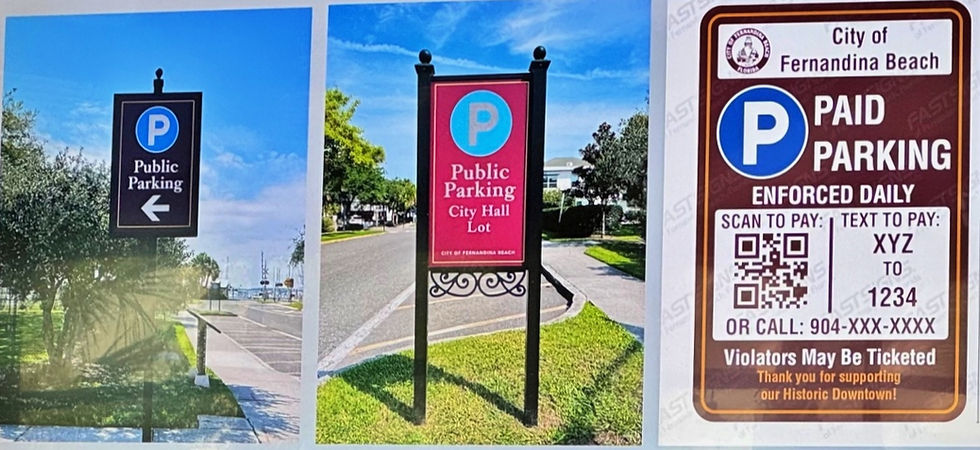
The Fernandina Beach City Commission took a pivotal step Tuesday toward implementing the city’s first paid parking system in decades, voting 3–1–1 to approve Ordinance 2025-13 on first reading. The ordinance would establish paid parking across roughly 900 downtown spaces and create a dedicated fund for long-delayed riverfront/downtown infrastructure projects.
Vice Mayor Darron Ayscue voted against approval, while Commissioner Tim Poynter abstained after disclosing what he described as a “perceived conflict” involving business properties he owns or leases within the defined paid parking area.
The paid parking program only becomes official following a final city commission vote scheduled for Jan. 6, 2026, after the required public notice and an additional attorney-client executive session.
City Attorney Teresa Prince began the ordinance discussion disclosing that the Florida Commission on Ethics had issued a verbal opinion finding “no voting conflict” under state statute, but said Poynter had requested a written opinion and would abstain from voting until it arrives.
That was followed by Poynter reading his disclosure: “I own or lease seven of the 460 parcels located within the downtown boundary… Of those seven, I own or lease six parcels within the paid parking area where the paid parking will be implemented.”
Poynter later used his discussion time to deliver one of the strongest defenses of the ordinance, arguing the city could no longer delay funding major capital projects.
“Waiting five more years (to do improvements) — you think it's going to be cheaper?… It doesn't get cheaper. It just gets more expensive. This commission… they aren’t taking this down. They are doing the right thing.”
He criticized decades of inaction by previous commissions:

“Being a one-off commissioner… you just don’t get things done. And that’s what has been the scenario for decades. For decades,” Poynter said of his first term on the commission when he was voted down on proposals.
Poynter cited an example from 15 years earlier: “Alachua (street)… was going to cost $165,000 to open… It was $1.79 million to open it up this time,” Poynter said.
He argued the burden of paying for downtown improvements should extend beyond the city’s 8,000 residents:
“Where are we going to come up with the dollars? This is a plan to ask other people to help contribute so it's not on the backs of the 8,000 people who are paying for everything.”
Though he could not vote Tuesday, Poynter concluded: “Although I can’t vote tonight, I will be… I'll be voting on the second reading.”
Commissioner Joyce Tuten, said she was conflicted about the measure, but framed paid parking as an overdue corrective for decades of unfunded mandates.
“Decades of policy that we should fix downtown… build a seawall… maintain Brett’s — those are unfunded policies.” she said. “This city didn’t always get a million tourists… They are using and abusing [infrastructure]… Asking a million tourists to kick in a few dollars to use our downtown is fair.”
Tuten also argued that the city charter already guarantees a referendum — the August 2026 vote triggered by anti-paid parking citizens' petition — ensuring the public will have the final say:
“We need to let the citizens speak, and they have… This will go to a vote in August… regardless of what this commission does.” Tuten said.
Despite acknowledging public anxiety over the rollout, Tuten said doing nothing would be worse.
“I recognize it is scary… it is a scary vote for me… But I stand with what Commissioner Poynter said — that it's very important… that we address these infrastructure projects.”
Tuten pointed to the deteriorated state of Brett’s Waterway Café as an example of deferred maintenance compounding over generations:
“These projects… were decades in the making by literally tens of thousands of residents who lived here, died here, moved away… Why do we now bear the burden?” she asked.
Ayscue, the lone dissenting vote, again urged the commission to delay implementation until after a referendum.
“I just don’t understand the thought process behind just not allowing the citizens to have the say first,” Ayscue said warning that committing to signs, systems, and vendor costs before a public vote would undermine trust. “This commission has the opportunity to put this to a vote before you implement a single sign… We have the availability to hold a vote before that happens.”
He also questioned the framing of the paid parking period as a long-term “test,” noting that “we're talking about the first of April… we’re literally looking at four months until the vote happens.”
The 17-page ordinance outlined the following:
• Creates Division 2 – Paid Parking within the city code
• Establishes the downtown paid parking area (Ash Street to Alachua Street, Front Street to just before 8th)
• Creates a Parking Fund restricted to downtown revitalization, infrastructure, and resiliency uses
• Authorizes hourly fees, dynamic pricing limits, and permit systems
• Provides two free resident digital permits per household (each with four hours/day free)
• Provides a 20-minute free grace period for all users
• Prohibits meters; signage and mobile pay would be used instead
• Requires a 30-day education period before enforcement• Gives the vendor six weeks after adoption to stand up the program
City Attorney Prince reiterated that nothing approved Tuesday puts the paid parking system into effect.
“This was the first reading… It is not enacted yet,” she said.
The anti-paid parking citizens' group has filed for an injunction in Nassau County Court to block the city from implementing the program until the August vote. That case is currently being litigated.
Four speakers addressed the commission. Several raised concerns about fairness, business impacts, and potential future changes to the resident permit system.
One resident warned that removing resident permits “two or three years down the road” could be used as a revenue tactic and urged commissioners to avoid “a bad, bad thing to do.”
Supporters emphasized downtown infrastructure needs.
“I support paid parking because it requires non-city residents to contribute to the financing of amenities they enjoy… I urge others to vote to retain paid parking to maintain equity and fairness in how we fund projects,” resident Richard Deem said.
If commissioners approve the ordinance on January 6, setup will begin immediately, with a likely “go-live” in mid-April 2026, followed by an August voter referendum that could keep or repeal paid parking.


Comments